Physics-informed AI
Learning systems that incorporate scientific knowledge for stability, interpretability and reliable generalisation.
Research across Singapore & Australia
We are the Real-world AI Lab (RAIL), a cross-disciplinary research group developing practical, reliable AI technologies with measurable impact. Our work bridges cutting-edge machine learning with hydrology, environmental modelling and deployable systems.


Learning systems that incorporate scientific knowledge for stability, interpretability and reliable generalisation.
Fast, high-resolution flood mapping and operational forecasting for resilient communities.
Multi-source data fusion and spatio-temporal learning for rainfall and water-resource challenges.
From the lab
Recent awards, talks, collaborations and research milestones.

Google awarded US$50,000 in TPU credits for DualFloodGNN-TPU: A Scalable Physics-Informed Graph Foundation Model for Large-Scale Hydrodynamic Flood Simulation.
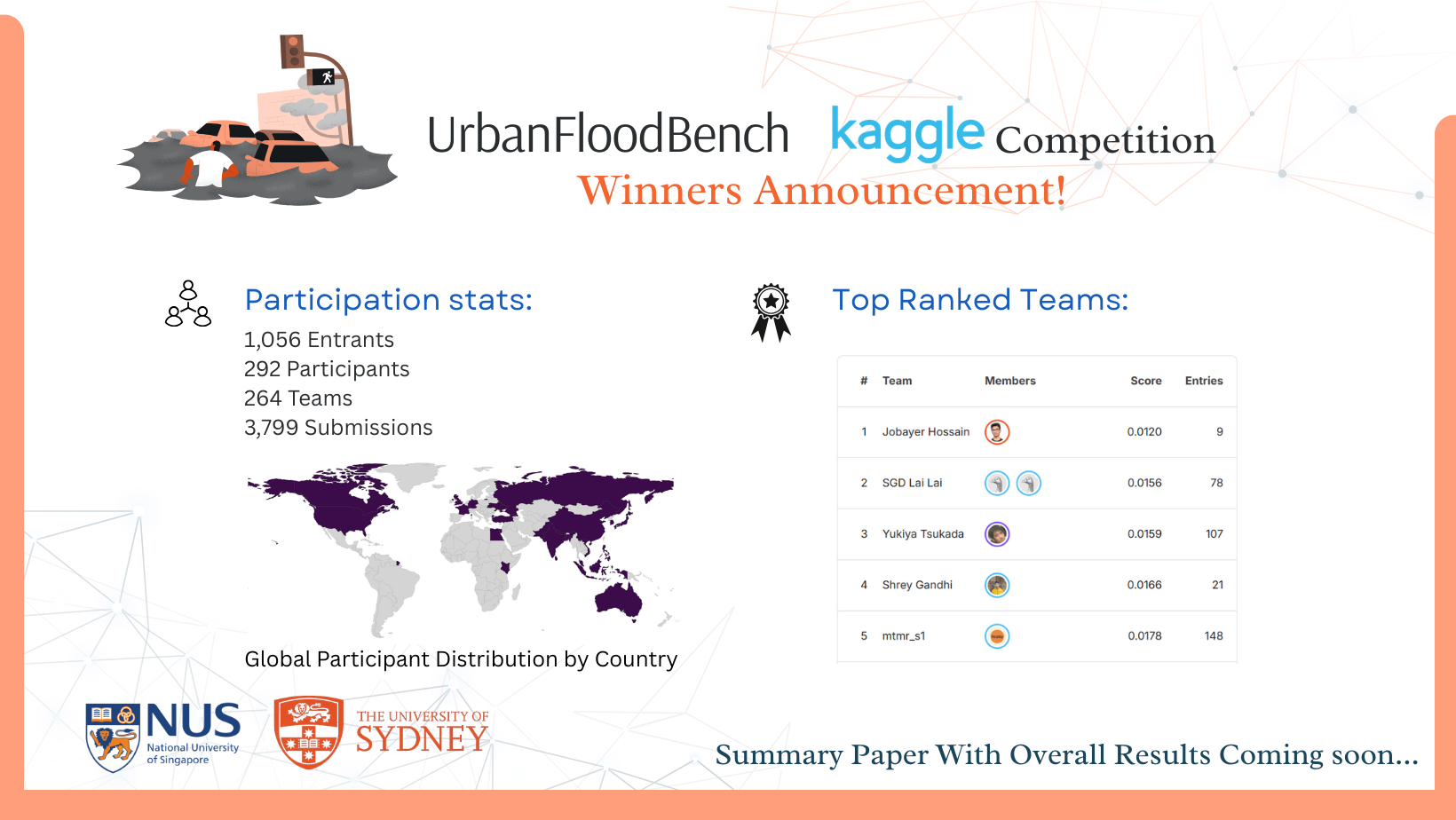
The competition attracted 292 participants and 3,799 submissions from more than 20 countries. Congratulations to champion Jobayer Hossain, runners-up SGD Lai Lai and Yukiya Tsukada, and finalists Shrey Gandhi and mtmr_s1.
Competition results →
Launched in January 2026, the competition advances urban flood forecasting in coupled 1D–2D hydraulic systems by predicting water levels across drainage and surface nodes.
Visit the competition →
Joint funding supports physics-informed deep learning, a benchmark dataset and a global AI challenge for climate-resilient cities.

Sun Han Neo received the OURP 2025 for Physics-Informed Generative AI for High-Resolution Flood Mapping.
Professor Lucy Marshall delivered a plenary address on environmental modelling and leadership at the 26th International Congress on Modelling and Simulation in Adelaide.
Event details →Dr Sanka Rasnayaka presented the team’s research at the 26th International Congress on Modelling and Simulation in Adelaide.
Dr Viraj Herath and Dr Sanka Rasnayaka discussed operational flood modelling and interdisciplinary collaboration.
Dr Viraj Herath was recognised for Hydrologically Informed Generative AI for High-Resolution Flood Mapping.
Dr Viraj Herath and Prof Lucy Marshall presented advances in generative AI for high-resolution flood mapping for the ARC DARE Seminar Series.
Watch the seminar →People
A cross-disciplinary group spanning AI, hydrology, environmental modelling and engineering.
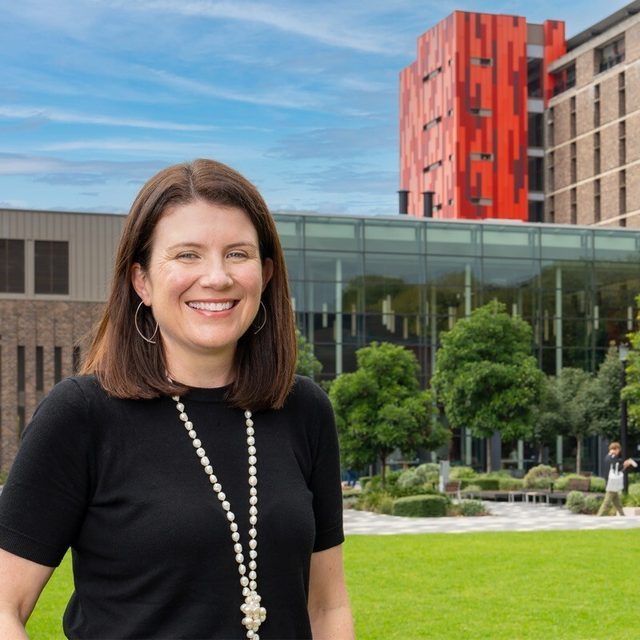
Deputy Vice-Chancellor (Community and Leadership), The University of Sydney
An expert in hydrology and water resources, environmental model optimisation, Bayesian inference and uncertainty quantification.
Google Scholar →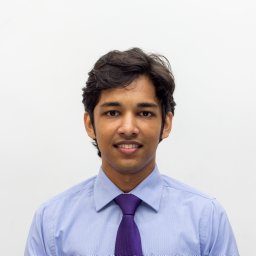
Lecturer, National University of Singapore
Leads research in applications of AI and machine learning across physics-informed AI, biometrics, large language models and computer vision.
Google Scholar →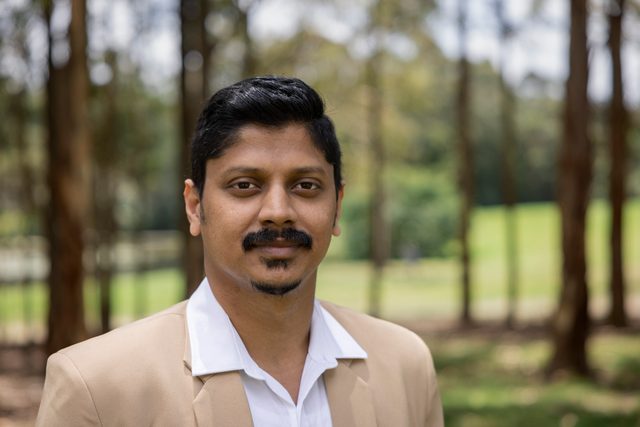
Research Fellow, The University of Sydney
Works in hydroinformatics and physics-informed machine learning, with a focus on flood modelling, hydrodynamic simulation, rainfall forecasting and rainfall–runoff modelling.
Google Scholar →
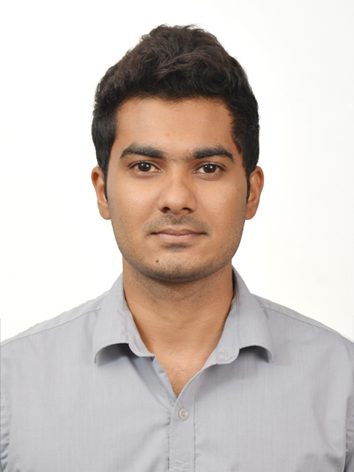
Postdoctoral Research Associate · The University of Sydney
Statistical data science, remote sensing and environmental modelling.
LinkedIn →
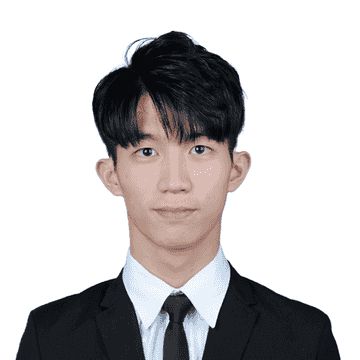
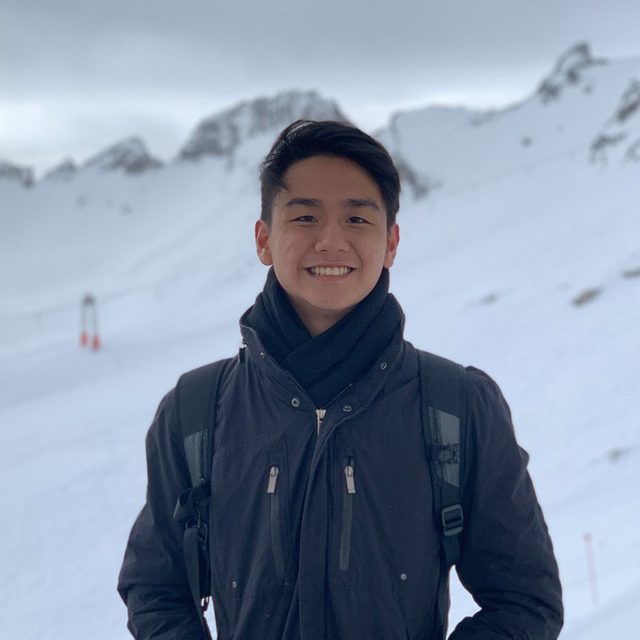
FYP Student, The University of Sydney · Joined 2026
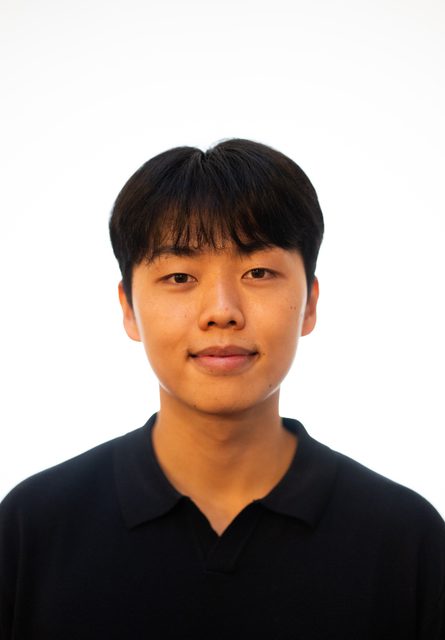
FYP Student, The University of Sydney · Joined 2026
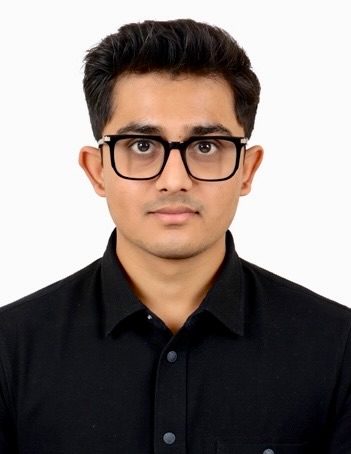
Master’s Student, The University of Sydney · Joined 2025
| Name | Role | University | Year | Thesis / research topic |
|---|---|---|---|---|
| Research Assistant | NUS | 2025 | Physics-informed graph neural networks for operational flood modelling | |
| FYP Student | NUS | 2025 | Modelling spatial rainfall distributions with heterogeneous graph neural networks | |
| UROP Student | NUS | 2025 | Memory-limited physics-informed graph neural networks for operational flood modelling | |
| Master’s Student | NUS | 2025 | Physics-informed graph neural networks for operational flood modelling | |
 Neo Sun Han Neo Sun Han | FYP Student | NUS | 2024 | Physics-Informed Generative AI for High-Resolution Flood Mapping |
| Research Assistant | USYD | 2025 | Ecohydrology and hydroclimate modelling |
Research
Machine learning shaped by physical insight and real operational needs.
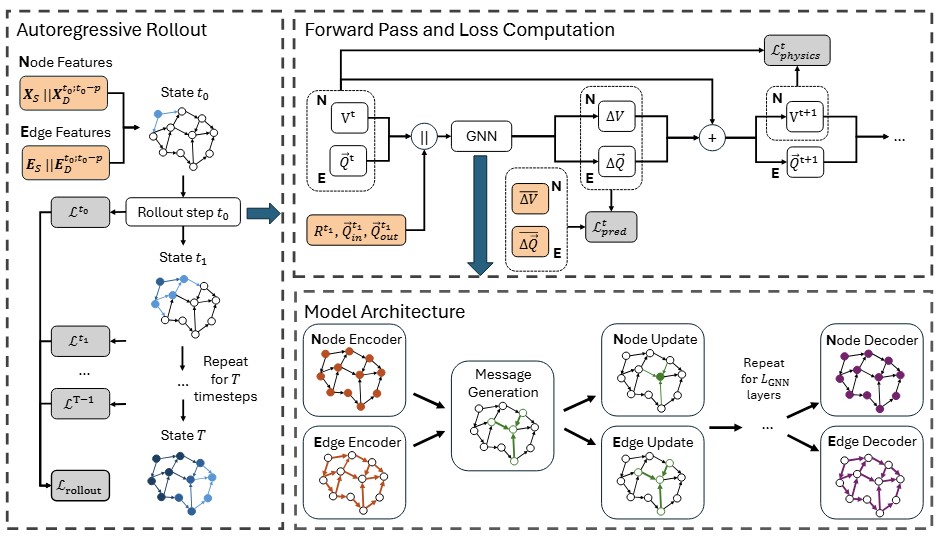
DUALFloodGNN is designed for efficient, accurate flood modelling over unstructured spatial domains. Unlike image-based deep-learning methods, its graph representation follows the node-and-link structure used by numerical hydrodynamic models.
The architecture embeds physical constraints at both global and local scales and jointly predicts water volume at nodes and flow along edges. Multi-step prediction and curriculum learning improve autoregressive stability, allowing the model to outperform established GNN flood models while retaining the speed required for operational forecasting.
Researchers: Carlo Acosta, Sanka Rasnayaka, Jia Yu Lim, Lincoln Yao, Viraj Vidura Herath, Abhishek Saha and Lucy Marshall.
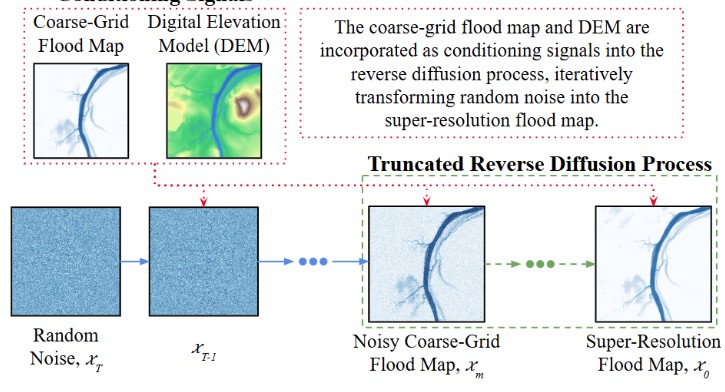
Flood-LDM uses latent diffusion to transform coarse-grid flood simulations into high-resolution maps with near fine-grid accuracy. This substantially reduces the computation needed for large-scale prediction and makes rapid flood-risk analysis more practical.
The method generalises across different geographic regions, while transfer learning enables fast adaptation to new locations. Physics-informed inputs also improve interpretability and reliability, addressing a central limitation of purely black-box flood-modelling systems.
Researchers: Neo Sun Han, Sanka Rasnayaka, Sachith Seneviratne, Viraj Vidura Herath, Abhishek Saha and Lucy Marshall.
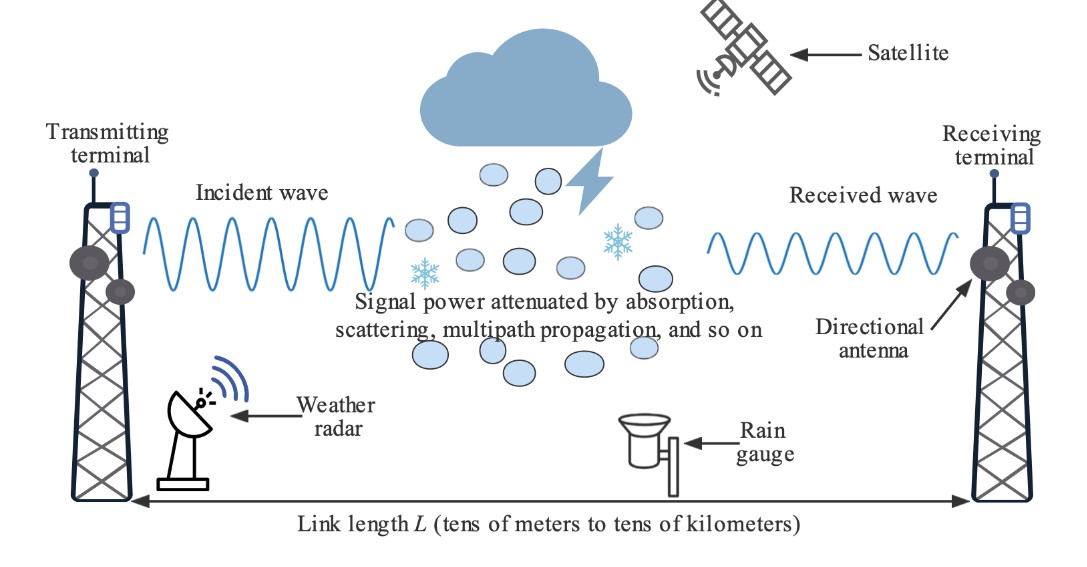
This project investigates quantitative precipitation estimation where sparse rain gauges and conventional stationarity-based geostatistical methods struggle. Singapore’s highly variable convective rainfall provides a demanding real-world testbed.
Heterogeneous graph neural networks combine multiple rainfall data sources and learn complex, nonlinear spatial relationships. The aim is to reduce uncertainty in precipitation estimates and strengthen downstream applications including urban flood modelling and real-time hydrological forecasting.
Researchers: Low Jun Yu, Sanka Rasnayaka, Jia Yu Lim, Viraj Vidura Herath, Abhishek Saha and Lucy Marshall.
Outputs
Peer-reviewed and forthcoming work from the lab.
Open research
Research datasets and supporting material made available through the University of Sydney repository.
Benchmark dataset
UrbanFloodBench is an open and reproducible benchmark for testing and comparing data-driven surrogate models for coupled urban flood systems. It contains rain-on-grid simulations for four coupled 1D drainage and 2D surface-flow domains: Beaver Lake, Davis, New Orleans and Coogee.
The simulations were generated with HEC-RAS 6.7 Beta 4a and processed into a machine-learning-friendly format. Each model includes full synthetic rainfall-event outputs, dynamic simulation variables, static node and link attributes, and geospatial shapefiles. The Beaver Lake and Davis models formed the basis of the international UrbanFloodBench Kaggle competition.
Creators: Jia Yu Lim, Viraj Vidura Herath, Sanka Rasnayaka, Lucy Marshall, Hui Zou and Abhishek Saha.
Graph learning dataset
This dataset contains 2D hydrodynamic simulation outputs and associated geometry files used to train and test the graph neural network models presented in the DUALFloodGNN research. The graph representation supports learning water volume at nodes and flow along edges over an unstructured flood domain.
Flood simulations were generated using HEC-RAS. The Wollombi catchment digital elevation model was sourced through Australia’s ELVIS elevation portal, while synthetic forcing data was adapted from prior work on interpretable physics-informed graph neural networks. A README documents the dataset structure and usage.
Creators: Viraj Vidura Herath, Carlo Malapad Acosta, Jia Yu Lim, Abhishek Saha, Sanka Rasnayaka and Lucy Marshall.
High-resolution flood mapping
This dataset provides paired coarse-grid and fine-grid flood-depth maps together with corresponding digital elevation model inputs. The 512 × 512 pixel data was used to train and evaluate the SGUnet and Flood-LDM deep-learning models for rapid, high-resolution flood mapping.
HEC-RAS simulations cover three Australian catchments: Wollombi, Burnett and Chowilla. Flood depths are supplied in centimetres and DEM elevations in metres. The paired structure supports supervised learning, super-resolution and zero-shot generalisation experiments; because of its size, the repository distributes the collection in multiple parts.
Creators: Viraj Vidura Herath, Lucy Marshall, Abhishek Saha, Sanka Rasnayaka, Sachith Seneviratne and Sun Han Neo.
Work with us
Join a collaborative research environment focused on meaningful real-world applications of AI.
For students admitted to the NUS Computing PhD programme with a research scholarship and an interest in real-world, physics-informed ML.
For third- and final-year NUS undergraduates seeking a thesis or research project in real-world AI and physics-informed architectures.
For prospective PhD candidates and final-year thesis students applying ML and AI to water-resource challenges.
Roles across NUS and the University of Sydney for researchers in machine learning, computer vision and related areas.
There are currently no open positions in this category.
Start a conversation
For collaborations, student projects and research opportunities, contact one of the lab leads.
School of Computing, National University of Singapore
13 Computing Drive, Singapore 117417
Room 369, Building J05, School of Civil Engineering
225 Shepherd St, Darlington NSW 2008